
By Cécile Pellerin, Analyst at XAnge
In August 2026, SoftBank invested $200M in Gravis Robotics, an ETH Zurich spin-off that retrofits excavators so they can dig on their own. This was a Series A round at a $1bn valuation. Two or three years ago, a ticket that size at that stage would typically have gone to a chatbot or a coding assistant.
That deal says a lot about where AI is heading. Until recently, most of the transformations happened behind screens: chatbots, copilots, agents, code generation... More and more, it is now moving to factories, power grids, construction sites and mines, where a model’s output is no longer a paragraph of text, but a decision about a weld, a battery dispatch or the path of a 30-tonne machine.
This map is an état-des-lieux of that shift. It is not exhaustive, because the space moves too fast for that. But it shows where we see AI creating real value in industry today, and where we expect the next European champions to come from.
Below, we go through the five segments of the map, the trends we are tracking and what we look for as early-stage investors. We built the map around the buyer. Indeed, in industry, who signs the purchase order largely determines how long the sales cycle is, what ROI the product has to prove and how the company ends up being organised.
That gives us five segments:
- AI-native manufacturing. Inspection, predictive maintenance, process optimisation, simulation and digital twins. It’s sold to plant managers, quality teams and engineering departments.
- AI x Energy. Battery optimisation, flexibility, forecasting, grid planning and data centres. Sold to asset owners, utilities, traders and grid operators.
- AI x Physical Operations. Autonomy and orchestration on construction sites, in ports, mines and heavy-equipment fleets. Often sold to the people who run those sites and fleets.
- AI x Industrial Knowledge Work. Software that makes sense of technical documents, maintenance logs and engineering data. Sold to engineering, maintenance, compliance and procurement teams.
- Robotics / Physical AI. From foundation models and components to robots at work in factories, fields and hospitals. Usually sold to anyone with a physical task to automate.
What’s different this time
Industrial AI isn’t new. Factories have been buying machine vision and predictive maintenance software for over a decade. What has changed is that several things are happening at once.
First, the models have left the screen. “AI for industry” used to mean narrow models: one spots a scratch, another one flags an abnormal vibration. Vision-language-action models, world models and physics-informed simulation now give us far more general systems, able to read a scene, plan an action and drive a machine.
Second, the money has followed. European AI startups raised a record $23bn in H1 2026, 130% more than a year earlier and 55% of all venture capital invested in the region (HumanX & Crunchbase, 2026 European AI Economy Report). Physical AI took a large share of it: Wayve, Neura Robotics and Yann LeCun’s AMI Labs were among the six European startups that raised $1bn+ rounds over this period.
Third, Europe’s factories are short of people, and short of robots. Welders, building electricians and machine-tool operators are among the most widespread shortage occupations in Europe, and so are truck drivers and mobile plant operators (European Labour Authority, EURES report on labour shortages). Meanwhile, China installed 354 000 industrial robots in 2025, 59% of the world total, while installations in the EU fell 11% to 60,500 units (IFR, World Robotics 2026). Europe will not re industrialise without machines that need fewer people to run them.
Energy, too, has turned into a software problem. Europe installed a record 36 GWh of battery storage in 2025, up 48% year on year, which took its fleet past 100 GWh. SolarPower Europe expects annual additions to roughly quadruple by 2030. Every one of those batteries needs an algorithm to decide when to charge, discharge and bid. AI also brings its own energy problem: the International Energy Agency expects data-center electricity demand to more than double to around 945 TWh by 2030, slightly more than Japan’s total consumption today.
Brussels wants adoption as well. The European Commission’s Apply AI Strategy (which came out in October 2025) implements around €1bn, largely redirected from existing programmes, to speed up AI uptake in strategic sectors, manufacturing included.
Some things haven’t changed, though. Industrial buyers are still often slow and cautious, and every decision involves a long list of stakeholders. Pilots tend to drag on, integration with operational systems is painful, resulting in plenty of startups never making it past the POC. Capital is also extremely concentrated: 73% of European AI funding went to 38 companies raising rounds of $100M or more (HumanX & Crunchbase).
European, early-stage funds like XAnge typically have little access to the frontier-model layer. Below these mega-rounds, however, the applied layer is wide open, and that is where we think Europe’s next industrial champions could be built.
Where Europe can win
Given how much capital is already deployed in the US and China, Europe is unlikely to win the race for foundation models of the physical world. It probably won’t out-manufacture China on robot hardware either.
But the base layer is only part of the story. Most of the value in industrial AI could be captured higher up, where a model meets a specific plant, grid or site. That is where we think European founders have a real edge.
Europe is home to some of the most demanding industrial buyers in the world, in automotive, aerospace, chemicals and utilities, so customers are present. Germany alone accounts for 41% of industrial robot installations in the EU (IFR).
Fragmentation also works in Europe’s favor. As power markets differ from one country to the next, with their own balancing mechanisms and grid codes, and industrial regulation adds another layer of complexity European players are used to, while American players weren’t built for this.
Sovereignty now too shapes purchasing decisions : industrial companies are careful of sending process data or engineering files to a US hyperscaler. The same tendency that created demand for sovereign LLMs like Mistral and LightOn is now showing up in industrial software procurement.
Walking through the map
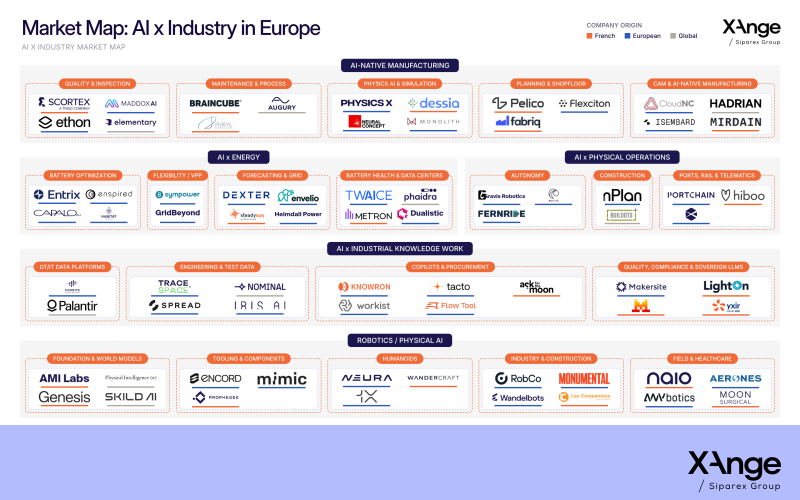
AI-native manufacturing
Inspection is the most mature segment and the most crowded, and it is already consolidating: French startup Scortex was acquired in 2022 by TRIGO, an Ardian-backed quality inspection group. Independent European players like Maddox AI (DE) and EthonAI (CH) compete with US startups such as Elementary and with incumbents like Cognex (US) and Keyence (JP).
Predictive maintenance is consolidating too. A few heavily funded players, Augury and Tractian for instance, lead the market. Siemens bought its way in the segment with Senseye in 2022, and in September 2026 Belgium’s I-care Group acquired the assets of Grenoble-based Amiral Technologies. Samotics (NL) in Europe remains independent.
A segment we find very promising for Europe is physics AI. Engineers designing a car, an aircraft part or a heat exchanger still rely on simulation software that can take hours, sometimes days, to compute how air flows around a shape, how a part deforms or how heat spreads.
Physics AI models learn from those simulations and from test data, then predict the result in seconds. Engineers can test thousands of designs instead of a handful, and build fewer physical prototypes. Europe has a strong bench here with for instance:
- PhysicsX (UK), which raised a $300M Series C at a $2.4bn valuation in June 2026;
- Neural Concept (CH), for aerodynamic and thermal design;
- Dessia (FR), which automates engineering design tasks.
The space is also attracting acquirers and M&A activity: CoreWeave bought London-based Monolith, which learns from physical test data, in 2025. These companies sell to R&D teams in automotive, aerospace and energy rather than to factory capex budgets, which usually means shorter sales cycles.
Other topics are also interesting, like AI-native manufacturers such as Isembard (UK) or Hadrian in the US, which run their own factories with AI instead of selling software. Mirdain (FR) goes one step further: it uses AI to turn a customer’s requirements directly into an optimised, manufactured part, without going through a manual design phase. Defence spending could accelerate companies like these, but their economics look more like an industrial business than a software one.
AI x Energy
Battery optimization is one of the fastest-moving segments on the map. Entrix (DE), enspired (AT), Capalo AI (FI) and Habitat Energy (UK, owned by Quinbrook since 2021) all go after the same battery owners, usually in exchange for a share of the revenue they generate. It’s one of the fastest ROI for an AI application, but the field is getting quite crowded. As the algorithms converge, we expect the winners to be the ones that can carry market risk for their clients, through revenue floors or tolling-style contracts.
Around them, Europe has built a strong ecosystem: flexibility (Sympower, GridBeyond), forecasting (Dexter Energy, Steadysun), grid software (envelio, Heimdall Power) and battery analytics (TWAICE).
We also see a gap in the market around data centers. The leading companies helping data centers consume less and work with the grid, such as Phaidra and Emerald AI, are American. A few European startups are emerging, like Dualistic (IT), which cuts energy use by optimising where workloads run, but they are still very early.
AI x Physical Operations
In this vertical, retrofit autonomy is a very interesting segment. Gravis Robotics (CH) and Fernride (DE) add autonomy to machines customers already own: excavators for Gravis, terminal tractors for Fernride. The customer doesn’t have to buy a new machine, which removes the biggest barrier to adoption.
Road autonomy (Wayve, Oxa, Einride) is a different game, today typically played at growth stage, where for instance Wayve has raised billion-dollar rounds. Construction planning (nPlan) and specialists in rail (KONUX), ports (Portchain) and equipment data (Hiboo) complete the picture.
Retrofit autonomy for other kinds of machines, such as cranes, agricultural equipment and airport ground support, looks to us like a very attractive early-stage thesis.
AI x Industrial Knowledge Work
This vertical can be split in two segments :
- Document search and technician copilots, which will will probably be absorbed by horizontal LLMs.
- Companies that own operational data and act directly on systems of record, with a stronger moat.
Cognite (NO) is Europe’s reference in industrial data, up against Palantir. Trace.Space (LV) and Spread AI (DE) focus on engineering data. Workist and Tacto (DE) automate quoting and procurement, where the ROI is immediate and the buyer is easy to identify.
A key question when looking at this company appears to be : “does the product write into SAP, Maximo or the PLM, or does it only read PDFs?”, as this will be a key question for the buyer.
Robotics / Physical AI
Foundation models soak up most of the capital. AMI Labs (FR) raised a $1.03bn seed in March 2026, Genesis AI (FR/US) came out of stealth in 2025 with $105M, and Physical Intelligence and Skild AI lead in the US.
Humanoids are a capital-intensive race, with Wandercraft (an XAnge portfolio company), Neura Robotics and 1X among the frontrunners. Commercial deployments are real, but still early.
For now, most of the revenue goes to specialists that do one task well:
- RobCo and Wandelbots (DE) in industry;
- Monumental (NL) and Les Companions (FR) in construction;
- ANYbotics (CH) and Aerones (LV) in inspection;
- Moon Surgical (FR) in healthcare;
- etc..
Tooling and components, like Encord (UK), Mimic (CH) and Prophesee (FR), are needed by every robotics company, whichever model wins. The question we always ask: is the robot paid for a task it can do today, or does it depend on a capability that doesn’t exist yet?
Warehouses, last-mile delivery and road freight are covered in our Logistics Market Map.
Where we see the biggest opportunities
One thing became clear while building this map: in industrial AI, the value is not necessarily where most of the money goes. The frontier-model layer is priced for a handful of global winners. The layers closest to the plant manager, the grid operator and the site director are still open.
In particular, we are watching five areas:
- Retrofit autonomy for industrial sites: construction sites, mines and ports will not be rebuilt for robots, yet Europe has to catch up on adding autonomy to the machines customers already own. Retrofit autonomy means they do not have to make a new capex decision, which makes adoption much easier.
- Tooling and components for physical AI: data, simulation, evaluation and critical hardware like robotic hands, sensors and edge chips. Every robotics company needs them, whichever foundation model wins.
- AI for engineering teams: simulation, requirements and design review. These tools are sold to R&D budgets, where sales cycles are often shorter, and Europe has a deep bench of technical founders in this space.
- Industrial software that acts on systems of record: we find interesting products that generate quotes or update compliance files directly in the customer’s systems. Tools that only summarise manuals will have a lower moat against general-purpose LLMs.
- Flexibility and grid software beyond battery trading: battery trading is getting crowded, but much less has been built for industrial sites that could adjust their consumption, for developers waiting to be connected to the grid, or for data centres that need to work with it.
To close
Past industrial revolutions produced generational companies, and they were rarely the ones with the most impressive technology. They were the ones that got it working inside the plants, networks and sites that run the economy. We expect physical AI to follow the same pattern.
Few things in particular came out of this map which differentiate the successful companies in the space:
- a deep understanding of the buyer and of how decisions are made on their side;
- a product that gets past the pilot and into production;
- an ROI the customer can measure quickly.
Industrial sales are slow, so the teams that win are often the ones that have worked in these environments before.
Europe has the factories, the grids, the engineers and the customers that need this technology the most, and we believe the next industrial AI champions can be built here.
If you are building in any of these categories, or if you think we got part of this map wrong, we would love to hear from you!


