By Cécile Pellerin, Analyst at XAnge
Stablecoins have quietly become core infrastructure beyond the world of DeFi and into global finance. In the past few years, they have shifted from a curiosity confined to crypto trading desks to the rails underneath a measurable share of global payment flows.
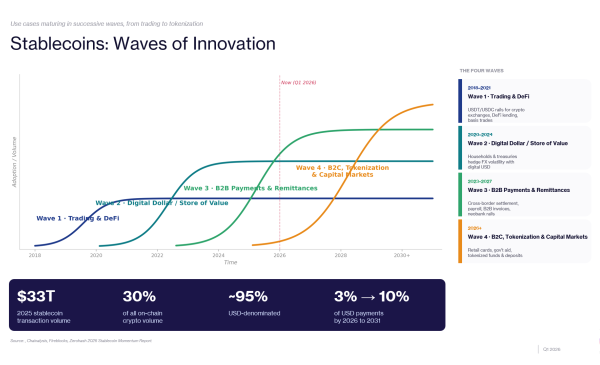
Total on-chain stablecoin volume crossed $33 trillion in 2025, a number that rivals Mastercard and Visa combined (respectively $14T and $9.2T in 2025). The MiCA regulatory framework launched in Europe in 2024 gives the foundations to turn theoretical use cases into investable businesses.
Many use cases show stablecoins are no longer a “crypto” story. They are a payment, lending, treasury and asset-issuance story. In the post below, we map the European landscape, share the trends we are watching, and explain what we are looking for in stablecoin companies.
Why now?
Three forces have converged in the last year and a half: the geopolitical environment has made stablecoins strategically necessary, the legal framework has gone from theoretical to operational, and the unit economics now beat the incumbent rails.
The geopolitical environment has changed. With the war in Ukraine entering its fifth year, the dollar openly weaponized through sanctions, and tariff escalation between the US, China and the EU, holding USD on a US bank rail is no longer a neutral choice for European corporates: it carries jurisdictional risk. In emerging markets where local currencies have lost 20 to 60% versus the dollar (Turkey, Argentina, Egypt, Nigeria), stablecoins have become a plausible savings instrument. The result is a structural pull on euro-denominated, MiCA-compliant stablecoins as a sovereign alternative to USD on-chain.
MiCA is no longer a theoretical framework, but a fully established system. Two years in, the first cohort (Circle EURC, SG–Forge EURCV, Monerium EURe, Angle agEUR) has been joined by AllUnity EURAU, StablR and Quantoz, all operating under EMI licenses from BaFin, the ACPR, the AFM and the CSSF. EUR stablecoin supply has grown roughly 5x since 2024, and for European corporates a euro stablecoin is now treated the same way as a euro IBAN. The US caught up in 2025 with the GENIUS and STABLE acts.
The use-case economics have flipped. Settlement on Ethereum, Solana, Base and Stellar is fast and cheap enough that a €50 cross-border transfer costs cents and settles in seconds. Tether, Circle and Paxos collectively manage over $250B in reserves yielding ~4.5%, which fuels their aggressive product expansion. On real corridors (EU–MENA, EU–LATAM), B2B settlement now clears at 30 to 80 bps versus 200-400 bps through correspondent banking. For a treasurer running weekly payroll, the switch pays for itself in one cycle.
The role of Europe in the stablecoin race
Europe is late to the game: more than 95% of stablecoins are US-backed today. However, we believe there is an untapped opportunity for the next generation of payment, treasury and tokenization infrastructure to be built by European founders.
Unsurprisingly, the US Dollar has won the issuance layer: a large majority outstanding stablecoin supply is USD-denominated, and the economics of a reserve-backed issuer reward incumbents (scale compounds, distribution compounds, and the income on reserves is a near-zero-marginal-cost asset) as shown by Tether and Circle’s almost-duopoly.
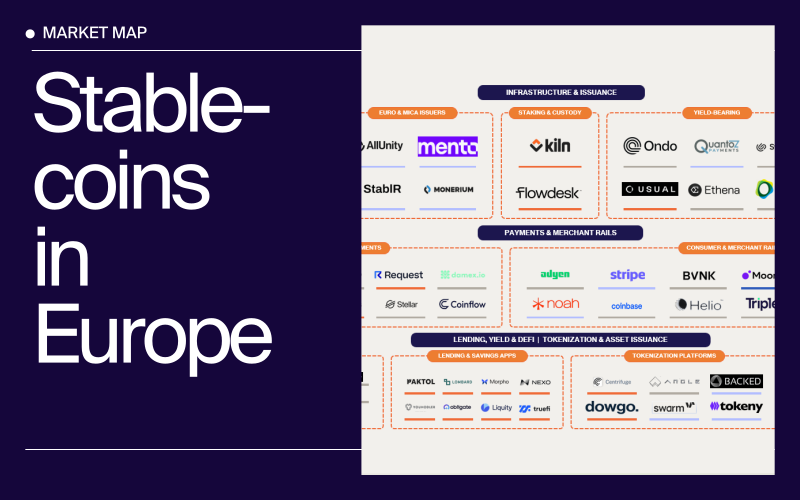
What is still up for grabs are the layers on top of issuance in Europe. The applications, the APIs, the merchant rails, the treasury tooling, the lending primitives and the tokenized assets. That is where we think European founders have a real shot, and it is the lens we applied when we built this market map.
Three main things act in favor of European founders:
- Regulatory base: MiCA, PSD3 and EMI licensing offer a strong regulatory base for European solutions, and corporates prefer counterparties that share their regulator, which are easier to naviguate from Paris than from San Francisco.
- Sovereignty: many European corporates or public institutions would prefer their on-chain euro economy to be run by a European-based company rather than a US corporation. The same logic that pushed cloud (OVH, Scaleway) and AI (Mistral) is starting to apply to payments.
- Currency-native product: a euro stack just isn't the same product as a USD one. Different corridors, different FX needs, different settlement timing, different banking partners. US players weren't built for it and can't easily retrofit.
Walking through the map
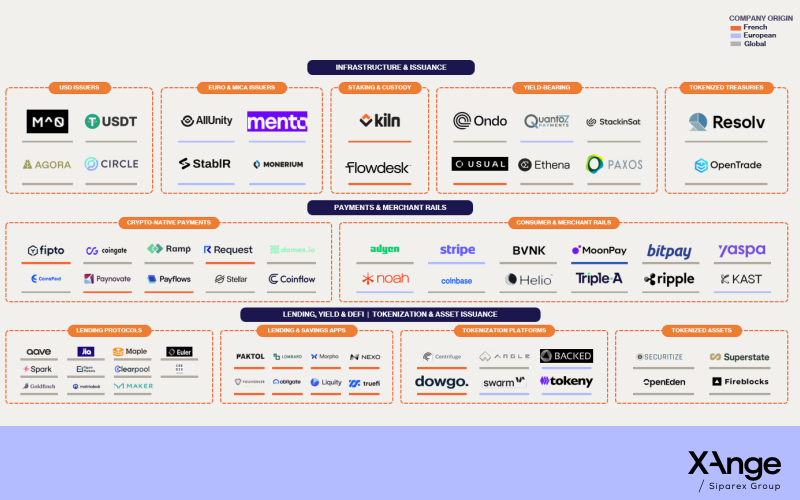
Infrastructure & Issuance
USD Issuers remain in a consolidated market: Tether (60% market share) and Circle (25% market share) dominate, with Paxos and a few newer entrants (Agora, M^0) cover essentially the entire market.
Euro & MiCA Issuers are an interesting but tough positioning on this map. AllUnity (DWS / Flow Traders / Galaxy) launched EURAU in July 2025 as the first fully-reserved, MiCA-compliant euro stablecoin. Monerium, StablR, Mento, Angle and Quantoz each take a different angle - bank-backed, fintech-native, DeFi-native, multi-jurisdiction - and we expect the market to narrow to two or three winners by 2027.
Yield-bearing stablecoins such as Ethena (sUSDe), Usual (USD0++), Resolv (USR) and StackInSat each offer yield in the 5-15% range, but the mechanisms range from “delta-neutral perpetual funding” to “tokenized T-bill with DeFi access” to “basis trade wrapped in a token.” They remain a niche part of the stablecoin offering.
Staking & Custody - Kiln, Flowdesk - are the under-priced middle layer. Every stablecoin issuer and every DeFi protocol needs institutional-grade custody and liquidity provisioning. The European players in this space have built enviable customer lists.
Payments & Merchant Rails
This is the most crowded band of the map and the one where the local-versus-global split is sharpest. We can split it in two:
The crypto-native B2B layer is where we find the most European players. Fipto (FR), Request (FR), Payflows (FR), Paynovate (BE), CoinsPaid (EE), BVNK (UK), Ramp (UK) and others are building the "Stripe for stablecoins": fiat on/off-ramps, KYB/KYT, multi-currency conversion, or treasury automation. Corridor mix (intra-EU, EU-MENA, EU-LATAM) and regulator overhead (MiCA, PSD3, EMI) give a strong basis to European founders. Fipto, a XAnge portfolio company, is one of the clearest winners on the European B2B side.
The consumer & merchant rails layer is the opposite: dominated by US and global players. Stripe, Coinbase, BitPay, MoonPay, Helio, Ripple, Triple-A were mostly built for US or APAC retail and arrived in Europe second. Stripe's acquisition of Bridge in 2024 and its 2026 stablecoin-native accounts for European SMEs were the biggest signals this layer is going mainstream - but most of the value sits on US balance sheets. The European challengers (Yaspa, Noah, Kast) are present but narrower.
The pattern holds across the map: the closer a layer sits to a regulated European corporate buyer, the more European the players. The closer to global retail or US merchants, the more US-dominated.
Lending, Yield & DeFi
This is the layer where the global players have most clearly won, with one big French exception.
The protocol layer is global and consolidated. Aave, Spark, Maple, Euler now handle institutional credit flows that would have been unthinkable three years ago — permissionless, non-jurisdictional, with TVL moats that make it almost impossible to launch a new general-purpose DeFi lending protocol in 2026.
Morpho is the exception that proves the rule. Founded in Paris by ENS and Polytechnique alumni, it became the de facto lending layer for real-world-asset strategies with a >$5B TVL, integrations with every major yield-bearing stablecoin and unicorn status this year. It works because it's protocol-first and jurisdiction-agnostic: being European didn't help or hurt, but the product just won on technical merit.
The local play sits one layer up, on the front ends and the regulated wrappers. Nexo, YouHodler, Liquity, Obligate, Figure Markets are the consumer and SME-facing apps, and this is where MiCA, PSD3 and EUR deposit matter. We can expect this layer to grow and move into B2C neo-wealth apps in the coming years using stablecoin rails to offer 4-6% yield on euro deposits, something a traditional bank cannot match.
Tokenization & Asset Issuance
Tokenization platforms - Backed, Centrifuge, Dowgo, Tokeny, Swarm - are the pipes that turn traditional assets (bonds, funds, private credit, carbon) into on-chain instruments.
Tokenized assets - Superstate, Securitize, OpenEden, Fireblocks - are the issuance and custody layer where the actual assets live.
The trigger we are watching is the ECB’s ongoing work on a wholesale CBDC and the upcoming DLT Pilot Regime extension. Once European treasurers can settle a tokenized corporate bond in central-bank money on-chain, the entire asset-servicing stack becomes addressable by startups rather than incumbents. That is a several-hundred-billion-euro market over the next decade.
The biggest market opportunities
What comes out of this market map is that many opportunities are still available for European players to position themselves in the stablecoin ecosystem. Notably, we keep an eye on actors emerging in these sectors:
1. European B2B payment orchestrators that turn stablecoins into an API for treasurers. The main use case today is facilitating transactions between underserved corridors (EU-to-MENA, EU-to-LATAM, EU-to-SEA).
2. Merchant rails and embedded finance that bring stablecoin acceptance to SaaS, e-commerce and marketplaces without requiring the merchant to know what a wallet is.
3. Tokenization infrastructure, especially around private credit, fund distribution and trade finance.
4. Compliance, risk and anti-fraud tooling built natively for on-chain flows (KYT, travel rule, sanctions screening).
5. Consumer “neo-savings” apps that offer regulated euro stablecoin yield to retail, under MiCA and PSD2.
A closing word
Every payment transition in history (from cash to cheque, cheque to card, card to mobile) has produced a generational platform company.
The move from correspondent banking to stablecoin-native settlement will be no different. Europe has the regulatory edge, the engineering talent and the corporate customers that need this technology. The winners are being built right now.
If you are a founder building in any of the categories above, or if you disagree with any part of this map, we would love to hear from you!
By Cécile Pellerin, Analyst at XAnge