Co-authored with Bastien Englebert, Analyst at XAnge
As white-collar hiring in France faces a second year of decline, the continued contraction marks a definitive end to the post-COVID era of "hiring for volume." French organizations are shifting from increasing and managing headcount to optimizing talent. In this environment, the HR office is reinventing itself and investing in an increasingly distributed, intelligent software stack.
The primary challenge is no longer just digitization: it is maintaining relevance in an automated world. We are moving away from traditional "digital HR" towards a world where an infrastructure able to support AI-native tools will be rewarded. In this world, data quality is king.
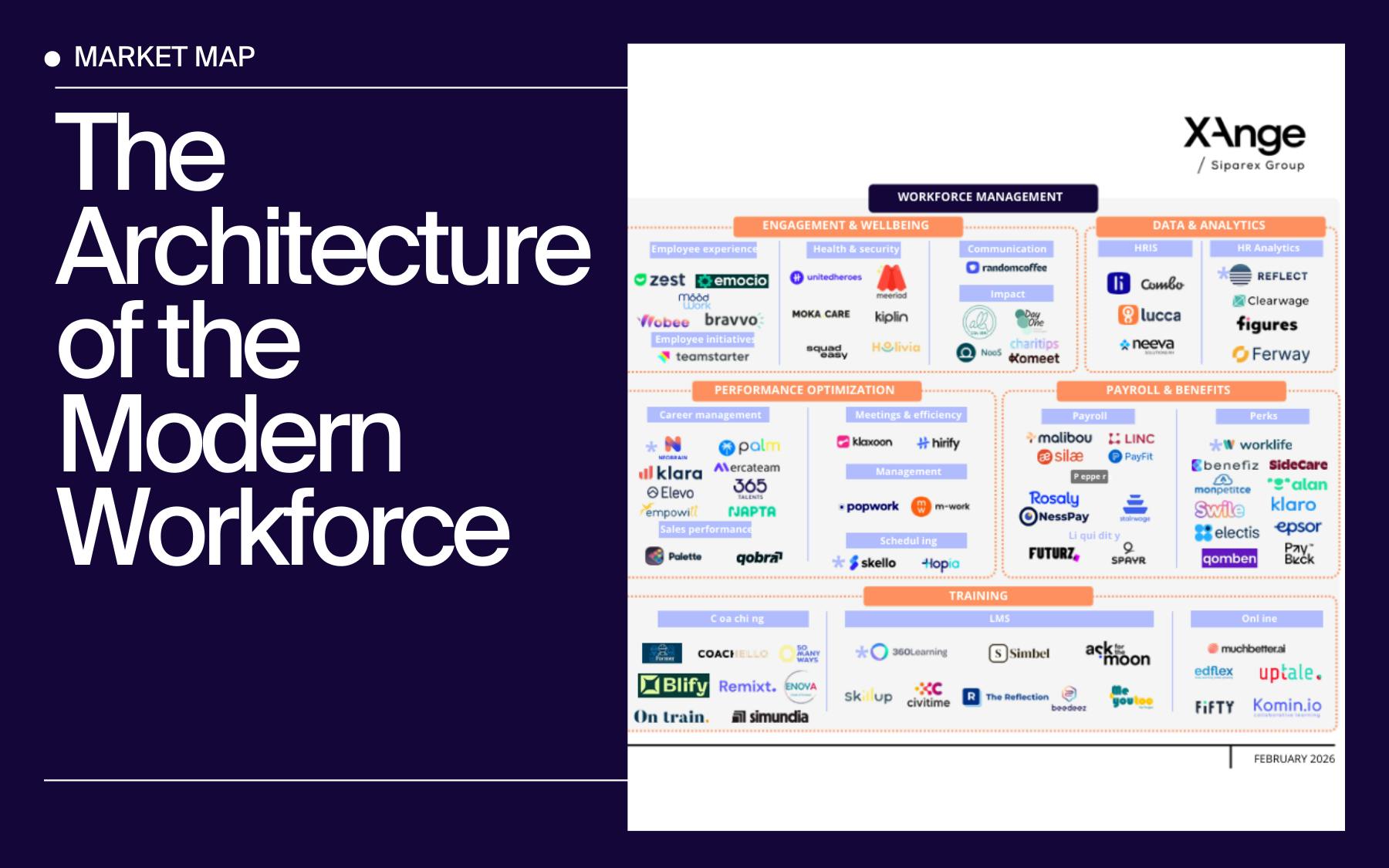
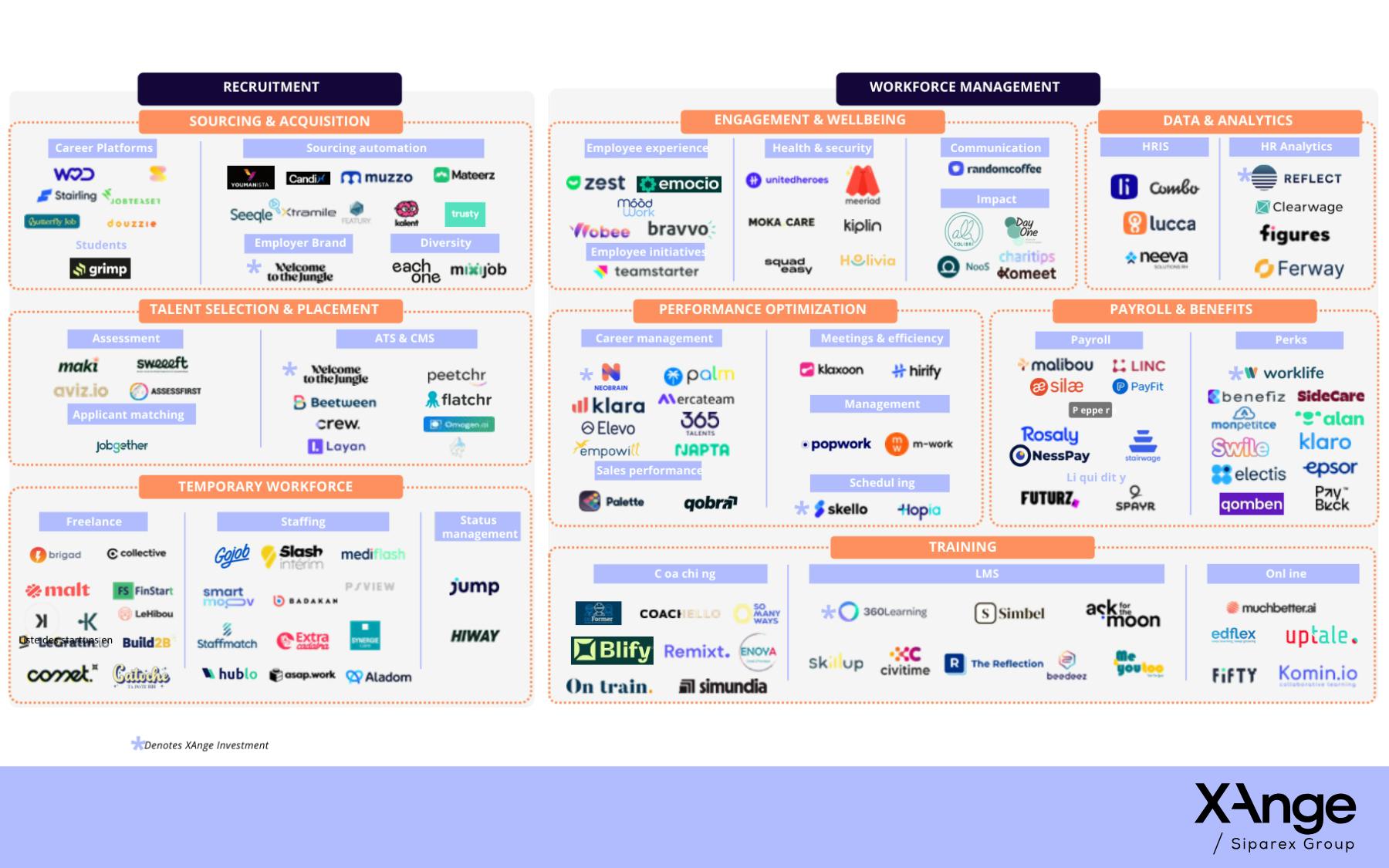
Each year at XAnge, we publish an HRTech market map with our view of the CPO’s tool suite. In our analysis, two large areas define the HR stack:
- The Left Pillar (Acquisition): The engines designed to identify, source, and sort talent with precision.
- The Right Pillar (Retention): The operating systems built to nurture, develop, and orchestrate the existing workforce.
PART I: RECRUITMENT
The Acquisition Engine
Before you can manage culture, you must build a team. The left side of the map reveals that recruitment has moved far beyond simple job boards into complex sourcing automation and gig-economy management.
01. Talent-Acquisition Platforms
This is the top of the funnel: targeted sourcing and is also where AI is currently driving the most momentum. Platforms such as Jack and Jill (UK), Talentium (Sweden), and Candix (FR) illustrate how AI is reshaping talent sourcing by automating candidate discovery, enriching profiles beyond CVs, and improving matching relevance. These tools increasingly enable access to passive, early-career, and hard-to-reach talent, while reducing sourcing friction for recruiters. Alongside these horizontal platforms, specialized vertical solutions continue to emerge, notably for student orientation and diversity-focused sourcing.
02. Talent Selection & Placement
Once candidates are in the pipeline, they enter a filtering layer. This layer is where the "applicant" becomes a "candidate." Historically, this has been the central nervous system of recruiting: the ATS (Applicant Tracking System). In France, Welcome to the Jungle has become a system of record and an employer branding hub for candidates. Newer, AI-native solutions like Omogen are integrating to ATSs and using AI to screen CVs and provide first voice interviews. Further down the hiring value chain, companies like Maki are deploying AI solutions for complex, specific candidate evaluations at scale.
03. Temporary Workforce
The non-permanent workforce is a massive category divided by worker type. Freelance platforms historically have targeted white-collar independent contractors, giving them the flexibility to work for large accounts while maintaining their independence. Verticalized, sector specific temporary workforce matching tools like Asap.work are optimizing for recruiting in high-tension labor categories.
PART II: WORKFORCE MANAGEMENT
The Retention & Operations Engine
The right hemisphere is about the employee lifecycle. Once the contract is signed, these tools take over to manage, pay, and grow talent.
04. Engagement & Wellbeing
Dedicated to the heartbeat of the organization, this area focuses on Employee Experience to measure engagement. It also cultivates community by powering social connections and team initiatives.
05. Performance Optimization
This suite of tools improves organizational efficiency. XAnge companies Neobrain and Skello assist with career management and efficient HR scheduling.
06. Payroll & Benefits
Payroll management is splitting into two modernized paths: streamlined outsourcing and internal automation. While Silae remains the historical reference, new entrants are redefining the standard. Linc modernizes the external model by equipping accounting firms, whereas Malibou provides an all-in-one internal suite for SMBs. This sector is heavily data-driven and currently ripe for disruption, with AI poised to automate complex compliance and processing tasks.
07. Training
The LMS model has long been undergoing a transformation, diversifying into two main approaches:
Collaborative Ecosystems: Platforms like 360Learning are continuing to deliver on the appeal of peer-driven, social learning. Newer entrants like Blify are capitalizing on conversational AI capabilities to provide personalized, continuous training plans. To function, these tools will need to rely on highly contextual data: beyond job descriptions and talent archetypes, true organizational context and training goals will need to be accessible and usable by platforms to provide truly useful training.
08. Data & Analytics
This final layer acts as the connective tissue between silos. As the HR stack fragments into specialized tools, data aggregation becomes the critical counterweight. In France, we see Reflect positioning itself to become the central data hub of the modern HR tech stack.
Takeaways
Looking at this landscape, two things are clear.
First, The French Ecosystem is Mature. With well established platforms like Welcome to the Jungle and point solutions like PayFit or Skello well into their hypergrowth journey, the ecosystem has moved from early-stage experimentation to massive scale. Despite clear market leaders, however, the HR tech stack remains fragmented. No 'All-in-One' HR platform has conquered the market in France; in fact, no vendor monopolizes the end-to-end process today, apart from ATSs that serve as a record system for candidate data. Consequently, the winning strategy for HR leaders in 2026 is not consolidation, but a 'Best-of-Breed' ecosystem.
As such, for organizations today, the challenge is no longer just selecting tools, but integrating them effectively. Success lies in how well these eight layers can be connected to create a cohesive and efficient environment for teams.
For HR Tech, the real frontier is data provenance. From sourcing to workflow automation, the 'garbage in, garbage out' principle remains the ultimate constraint: the sophistication of your output is strictly limited by the caliber of your input.
Co-authored with Bastien Englebert, Analyst at XAnge