By Lou Torineau, Analyst at XAnge
In March 2026, NVIDIA announced multi-billion-dollar supply agreements with optical component makers Lumentum and Coherent, a move that sent strong signals through both the semiconductor and venture capital worlds. Coming just months after Jensen Huang's demonstration of co-packaged silicon photonics at GTC 2025, these deals signaled something unambiguous: photonics is no longer a research curiosity. It is becoming the connective tissue of the next generation of AI infrastructure.
Photonics, the science and technology of light, is both a well-established field and an emerging opportunity in the AI era. Optical fiber communications have existed since the 1970s and reached individual homes in the 2000s, showing that transmitting information with light is far from new. Yet the unprecedented demands brought by AI are opening the door to a new wave of photonic innovation.
Before LLMs, data center optics were limited to inter-switch and inter-rack links using standard pluggable transceivers. The AI training revolution changed this entirely. When OpenAI trained GPT4 in 2023, it used a cluster of roughly 25,000 NVIDIA A100 GPUs, a scale that already pushed copper interconnects to their limits. By 2025, leading AI labs were building clusters of 100,000 or more GPUs, requiring bandwidth densities that copper simply cannot deliver efficiently. The physical limitations of copper, signal degradation over distance, electromagnetic interference, and heat generation, become acute at the speeds (400G and above) and densities required for modern AI workloads. This rapid progression from prototype to billion-dollar supply agreements in under two years reflects the urgency of the AI infrastructure buildout.
Compared to electrons, photons offer three fundamental advantages that make them particularly compelling for AI infrastructure:
- Lower energy consumption
- Higher conversion speed
- Greater bandwidth
The question at the heart of this article is simple: can photonics power the next generation of data centers?
Context: Why Photonics Now?
The surge in AI compute has created a demand for a new generation of data center infrastructure, one that is not only more powerful, but fundamentally more efficient. Photonics addresses three of the most critical constraints facing today's AI clusters.
Energy Efficiency
Power consumption has become one of the defining bottlenecks of large-scale AI deployment. Long-reach electrical SerDes (Serializer/Deserializer) typically consume around 10–20 pJ/bit. Co-Packaged Optics (CPO) bring this down to under 5 pJ/bit, and in some implementations significantly lower. At the scale of large AI clusters spanning tens of thousands of GPUs, this translates into megawatts of power savings; directly impacting operating costs, cooling requirements, and overall sustainability. As hyperscalers and AI labs face increasing pressure on energy availability and carbon footprint, this alone is a clear advantage.
Bandwidth Scalability
The bandwidth requirements of modern AI training workloads are staggering. GPU-to-GPU communication during large-scale training jobs demands simultaneous, high-throughput links across hundreds or thousands of nodes. Photonic interconnects enable scaling to terabits per second (Tbps) per package, which is essential for massively parallel GPU-to-GPU communication and multi-rack AI fabrics supporting large-scale training and inference workloads. Co-Packaged Optics removes the electrical I/O bottlenecks that increasingly limit system-level performance in next-generation AI architectures.
Latency Reduction
In synchronous AI workloads, communication delays directly impact scaling efficiency and time-to-train. By placing optical conversion closer to the compute die, photonic approaches shorten the electrical path, reduce the need for complex electrical equalization and retiming, and deliver lower end-to-end latency. In large distributed training runs where thousands of GPUs must synchronize gradients at every step, even marginal latency improvements compound into significant gains in overall efficiency.
A Quick Glossary
Before diving into specific applications, here is a reference guide to the key terms used throughout this article:
- Packages: Physical or logical units that integrate multiple components (chips, optics, interconnects) into a single module.
- Racks: Structured frames used to house and organize IT and network equipment (servers, switches, storage) in data centers.
- Silicon Photonics: A technology that integrates optical (light-based) components with silicon electronics to transmit and process data.
- Optical Interconnects: Replace copper interconnects by using light to link components (e.g., CPU/GPU/memory).
- Pluggable Optics: Removable optical modules (small transceivers) that convert electrical signals into optical signals between network equipment, widely deployed in today's data centers.
- Co-Packaged Optics (CPO): Integrates optical components directly within the same package as the switching circuits (e.g., a switch ASIC).
- In-Package Optical I/O: Optical I/O integrated within a processor or GPU package, enabling chip-to-chip connectivity using light instead of electrical connections.
- Chiplet: Small modular chips assembled like building blocks to create more complex systems, often combined with optical I/O to optimize bandwidth and efficiency.
- Photonic Integrated Circuit (PIC): A circuit that combines optical components (waveguides, lasers, modulators) on a single chip to transmit data using light rather than electrons.
- Electro-Optical Transceiver: A component that converts electronic data into optical signals and vice versa.
- Optical Switches: Devices that route optical signals between fibers or channels without converting them to electrical signals.
- Photonics co-processors: specialized chips that use light instead of electricity to accelerate specific computations.
Where Exactly Can We Find Photonics in a Data Center?
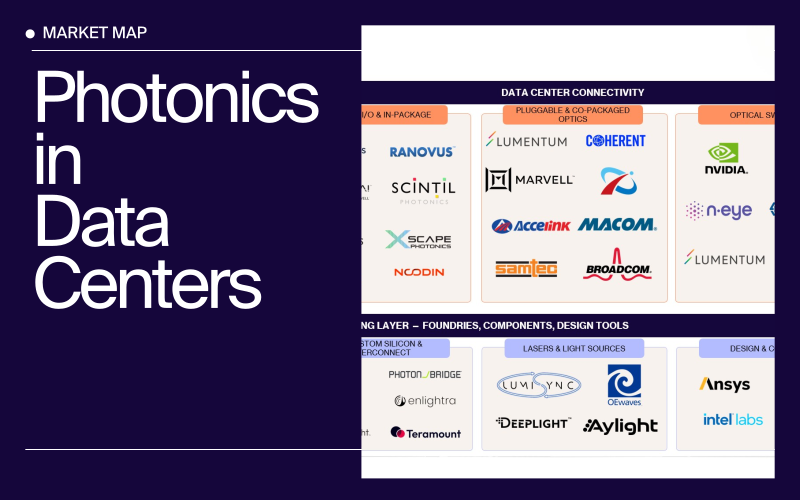
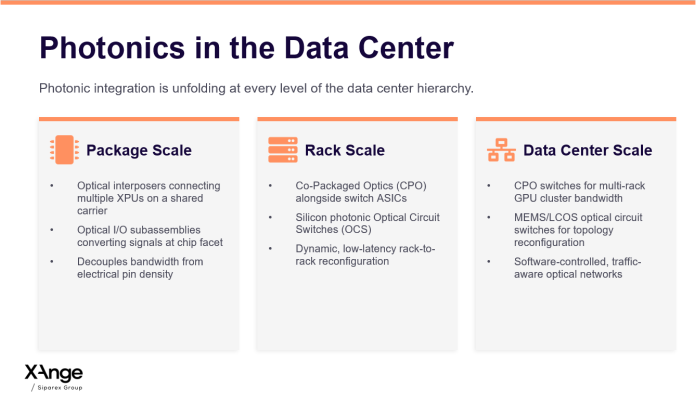
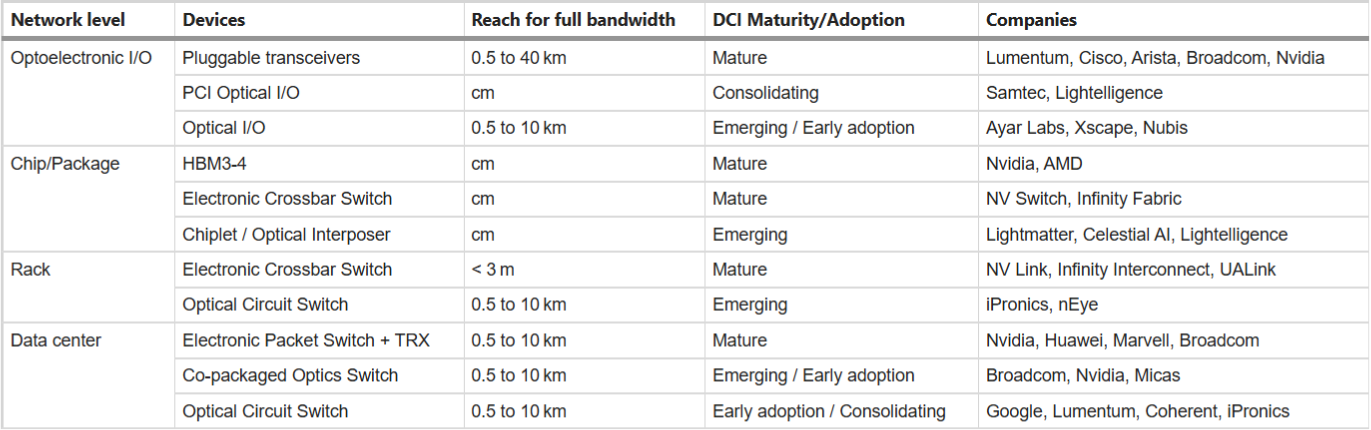
Photonic integration is unfolding at every level of the data center hierarchy, from the processor package itself to inter-building interconnects. Each scale carries its own technical challenges and opens up distinct commercial opportunities.
At the Package Scale
This is the most intimate level of integration, where photonics is embedded as close as possible to the compute dies.
- Optical interposers connect multiple XPUs (GPUs, CPUs, TPUs) on a shared optoelectronic carrier. By routing optical signals between chips at the package level, they drastically shorten the distance electrical signals must travel and remove a major bottleneck in chip-to-chip bandwidth.
- Optical I/O subassemblies introduce electro-optical interfaces that convert signals directly at the edge of the chip. They let data leave the package through optical fiber rather than copper traces, a fundamental architectural shift that decouples bandwidth from electrical pin density.
At the Rack Scale
At the rack level, photonics is driving the transition from pluggable optics toward more tightly integrated interconnect solutions.
- Co-Packaged Optics (CPO) integrates electronic switching within the rack while relying on fiber for the links themselves. Instead of attaching discrete pluggable transceivers to a switch, CPO places the optical engines directly alongside the switch ASIC in the same package.
- Optical Circuit Switches (OCS), paired with optical I/O solutions, enable reconfiguration of rack-to-rack links while avoiding conversions at intermediate switching stages.
At the Data Center Scale
At the broadest level, photonics is enabling a re-architecting of how data centers interconnect their compute clusters.
- CPO switches for the scale-out network are designed to handle the aggregate bandwidth of multi-rack GPU clusters, extending the benefits of co-packaging beyond a single rack.
- OCS based on MEMS and LCOS technologies allow software-controlled reconfiguration of the optical network topology. This capability is essential for traffic-aware architectures that need to reallocate bandwidth as AI training jobs evolve.
Maturity
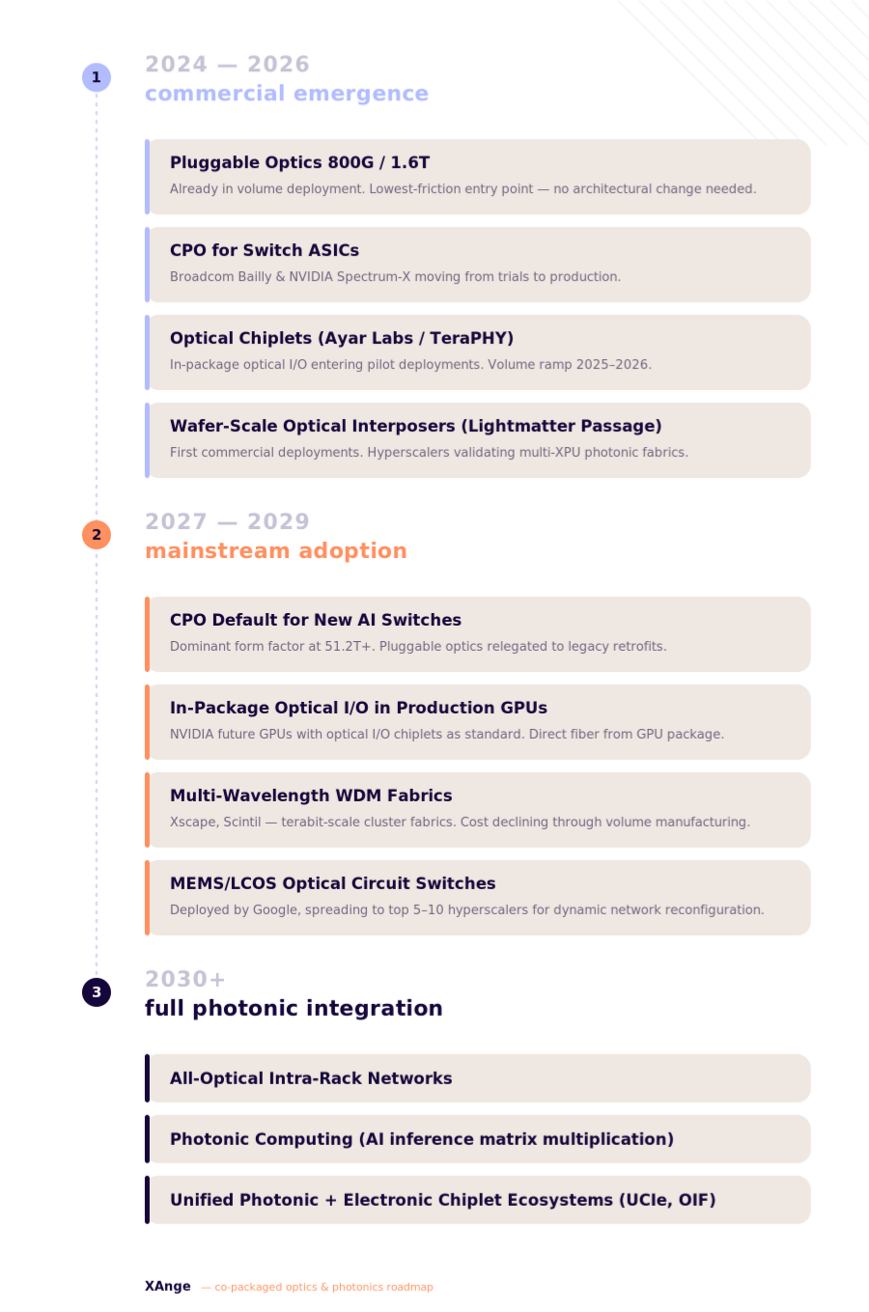
Adoption Chronology
Barriers to Entry
Despite its promises, integrating photonics into data centers at scale is far from trivial. Three challenges stand out.
Cost remains the primary obstacle. Silicon photonic components are more expensive to manufacture than their copper equivalents, and the ecosystem of suppliers, packaging houses, and testing facilities is still maturing. While costs are declining rapidly, driven by volume and process improvements, they remain a barrier to widespread adoption outside of the most cost-sensitive, bandwidth-hungry deployments.
Retrofitting existing infrastructure is complex. Most data centers were designed around electrical interconnects, and transitioning to optical requires significant changes to physical layouts, power distribution and network management software. Greenfield deployments can adopt photonics far more rapidly than the existing installed base.
Full-stack integration is perhaps the deepest challenge. Silicon photonics sits at the intersection of optics, electronics, materials science, and software-defined networking. Achieving a system that is reliable, manufacturable at scale, and compatible with existing workloads requires co-design across all of these disciplines simultaneously. A 100% photonic data center remains out of reach and unnecessary for now. The most compelling near-term opportunities lie at specific bottlenecks in the stack: chip-to-chip interconnects, CPO switching, and optical scale-out fabrics. These are the areas where the photon-over-electron trade-off delivers the clearest return on investment.
Market Overview
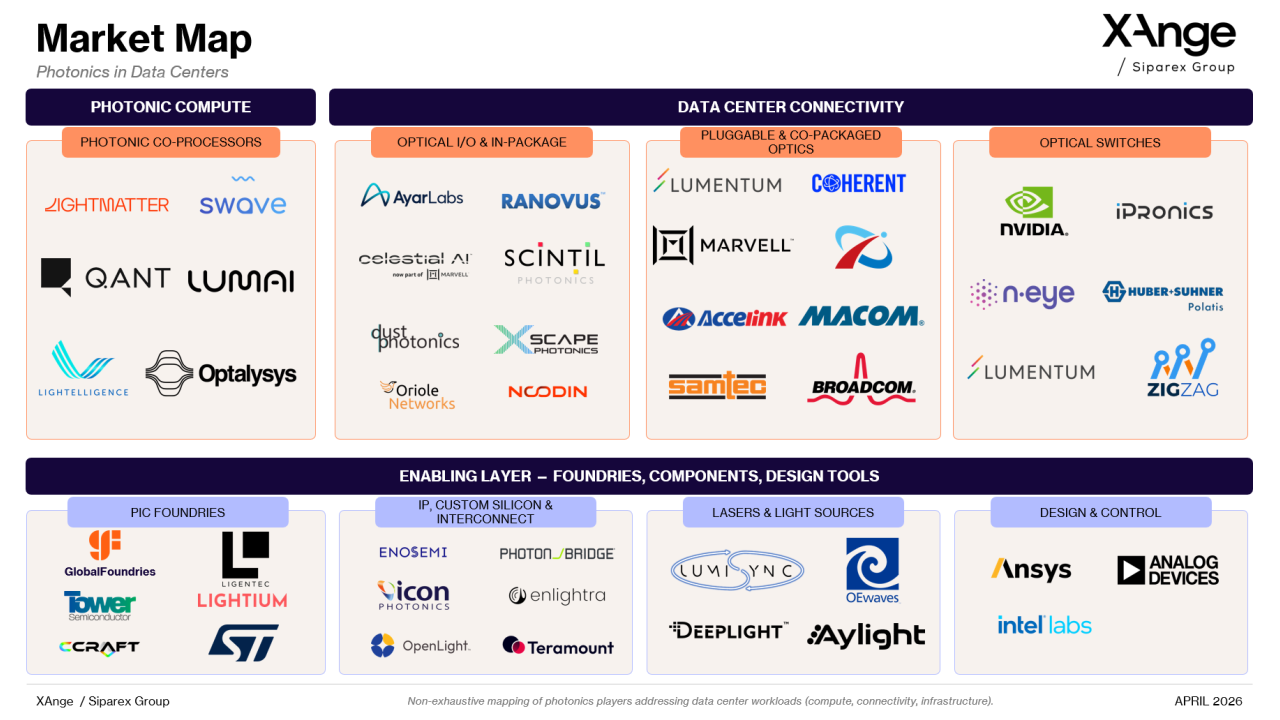
Latest Funding Rounds
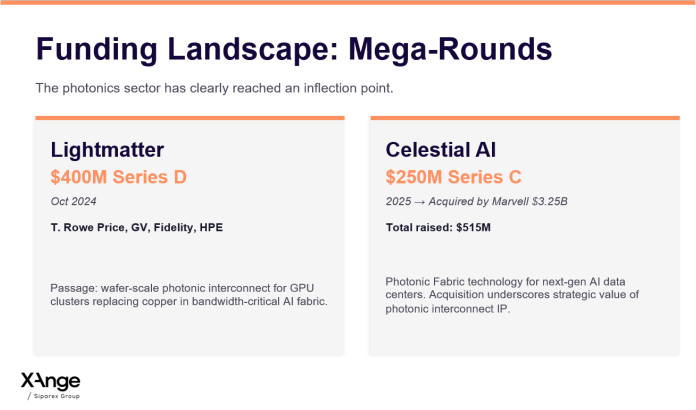
The photonics sector has clearly reached an inflection point, as evidenced by the scale and quality of recent fundraises.
Mega-Rounds
Lightmatter - $400M Series D (October 2024) led by T. Rowe Price with participation from GV (Google Ventures), Fidelity, and HPE Pathfinder. Lightmatter's flagship product is Passage, a wafer-scale photonic interconnect for GPU clusters that directly replaces copper in the most bandwidth-critical portion of the AI fabric.
Celestial AI - $250M Series C (early 2025) → acquired by Marvell for $3.25B (December 2025) Celestial AI had raised $250M in its Series C, bringing its total to $515M, before being acquired by Marvell to integrate its Photonic Fabric technology into next-generation AI data centers. The acquisition proves the strategic value that leading semiconductor companies now place on photonic interconnect IP.
Significant Rounds
Ayar Labs
- $155M
- Series D
- Optical Chiplets ( TeraPHY)
Xscape Photonics
- $81M
- Series A
- Multi-wavelenght WDM platform
Scintil Photonics
- €58M
- Series B
- Photonics ICs with integrated lasers
Teramount
- $50M
- Series A
- Detachable fiber-to-chip connectors
OpenLight
- $34M
- Series A
- PASICs for optical interconnects
Oriole Networks
- $22M
- Series A
- High-performance optical networking for AI
Takeaway
The sector has clearly reached an inflection point. Jensen Huang's public enthusiasm for silicon photonics at GTC 2025 significantly accelerated investor interest, and the dominant investment themes, co-packaged optics, chip-to-chip interconnects, and GPU cluster energy efficiency, are now well-established. US players lead on full-stack platforms and capital deployment, while European and Israeli companies carve out strong positions on critical components of the value chain.
Scorecard: What Needs to Happen Next
Realizing the full potential of photonics in AI data centers can be read on two levels: what needs to happen technically, and how an investor can position against it.
Technology readiness
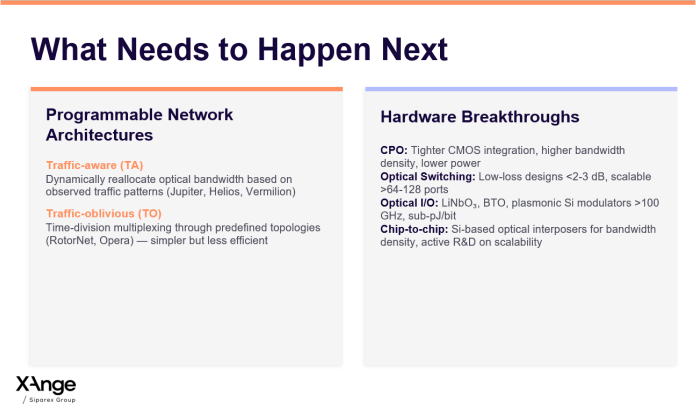
The first front is developing architectures that natively leverage optical reconfigurability. Traffic-aware (TA) approaches (Jupiter, Helios, Mordia, Vermilion) dynamically reallocate optical bandwidth based on observed or predicted traffic, requiring tight integration between the optical switching layer and the control plane. Traffic-oblivious (TO) approaches (RotorNet, Opera) cycle through predefined topologies via time-division multiplexing, simpler to implement, but with some efficiency cost for skewed traffic. Both are viable at scale and the right choice depends on workload and operational complexity tolerance.
The second front is hardware:
- On the CPO front, the main hurdles are tighter integration with CMOS, higher bandwidth density at the faceplate, lower power consumption compared to retimed electrical optics, and reliability that meets data center uptime standards.
- In optical switching, the field needs low-loss, large-scale integrated designs (for e.g. insertion losses below 2-3 dB, fiber-to-chip coupling under 0.5 dB per facet, and scalable OCS architectures beyond 64-128 ports at reasonable cost).
- For optical I/O, emerging materials like thin-film lithium niobate, barium titanate, and plasmonic silicon are enabling modulators with bandwidths above 100 GHz and sub-pJ/bit efficiency. Paired with next-gen CPO, these will bring unprecedented bandwidth and energy efficiency directly to the compute package.
- At the chip-to-chip level, silicon optical interposers can relieve bandwidth bottlenecks by increasing interconnect density, though challenges in interposer scaling, thermal management, and co-design with electronics remain active areas of research.
Investor scorecard
For an investor, the segments are far from equal. Optical switches stand out as the cleanest entry point with a sizeable, fairly mature market that sells directly to data-center operators rather than depending on NVIDIA's roadmap. The support layer around it (cooling, packaging, test) offers a similar logic, riding the photonics build-out without carrying the core technology risk. The enabling layer (foundries, lasers, optical engines) is more niche but also a credible European play, provided one picks carefully. The harder cases sit at the extremes. CPO has largely been captured by incumbents and is probably too late to enter, while in-package optical I/O remains a lab-stage bet tied to the GPU makers.
By Lou Torineau, Analyst at XAnge